
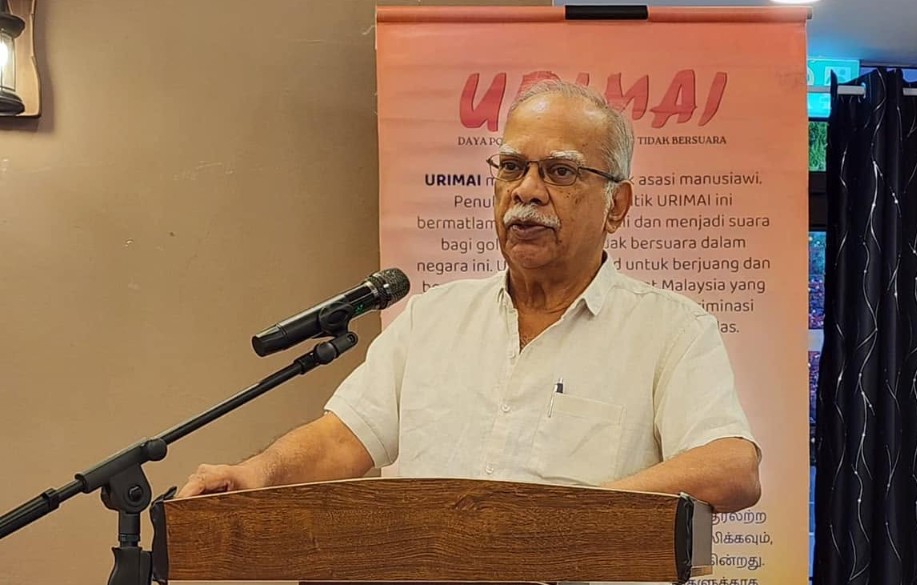
Ramasamy: “Why did Malaysia participate in the Bharat Summit 2026, which is Congress’s political battle against Modi?”
MEDIA STATEMENT BY PROF. DR. P.RAMASAMY,
CHAIRMAN, URIMAI PARTY
The recently concluded Bharat Summit 2026, held in Telangana, India, was more than just an international conference. It was also a carefully orchestrated political exercise involving the Congress Party at both the national and state levels. The summit, held on November 13 and 14, was intended, among other things, to internationalise the debate on democracy, political freedom, and governance in India.
With Congress leader Rahul Gandhi, the Leader of the Opposition in the Lok Sabha, given a prominent role, the gathering’s political significance could hardly be overlooked. Given the political intentions of the organisers, the event inevitably became a challenge to the ruling Bharatiya Janata Party (BJP). The Congress Party was clearly interested in taking India’s domestic political debates beyond its national boundaries and securing international attention for its criticisms of the Modi government.
It was against this political background that the Indian authorities reportedly prevented 115 international participants from attending the summit. Rahul Gandhi appeared keen to use the international platform to draw attention to what the Congress considers shortcomings in India’s democratic institutions and electoral processes.
The participation of international politicians, academics, journalists and civil society representatives provided an opportunity to give these concerns greater international visibility. Malaysia sent two participants to the summit, namely Nurul Izzah Anwar, Deputy President of PKR, and Kasthuriraani Patto, a former DAP Member of Parliament. Their participation, however, raises legitimate questions about the political judgement and diplomatic sensitivities involved.
Their presence at a Congress-backed political gathering could give the impression that the government of Prime Minister Anwar Ibrahim was sympathetic to the political concerns and objectives of the Congress Party, which is in opposition at the national level in India.
Surely, the two participants could not have been politically naive enough not to ascertain the political character of the conference in Telangana. While the agenda of the Bharat Summit included democracy, climate change, artificial intelligence, global cooperation and reform of international institutions, its political significance was inseparable from the Congress Party’s domestic struggle against the BJP.
In effect, the Congress Party was attempting to internationalise its political differences with the Modi government. This is a legitimate political strategy for an opposition party, but it also carries diplomatic implications when politicians from foreign governments participate.
The Malaysian government, by not apparently taking steps to address the political sensitivities surrounding the participation of the two politicians, might inadvertently have sent the wrong message to India. It is unfortunate that the Indian High Commission in Kuala Lumpur apparently failed to advise the Malaysian government adequately about the political character and implications of the Bharat Summit 2026.
Alternatively, perhaps the Malaysian government was already aware of the nature of the gathering but decided that participation by the two politicians was a matter for their respective political parties. Just imagine the Indian government sending its representatives to an international conference organised by an opposition political party in Malaysia, with the explicit intention of questioning the policies and legitimacy of the Malaysian government.
Would the Malaysian government be comfortable with such participation?
Was the participation of the two Malaysian delegates an instance of interference in the internal political affairs of India?
Or should it be regarded as legitimate participation in an international discussion about democracy and governance?
These are questions that deserve serious consideration.
Malaysia and India have longstanding diplomatic, economic and political relations. Both countries should be mindful of the sensitivities involved in participating in politically charged gatherings organised by the opposition. The two Malaysian participants should also explain the circumstances surrounding their participation.
Were they attending in their individual political capacities, or did they have any form of official endorsement from the Malaysian government?
Shouldn’t their respective political parties within the ruling PH coalition seek clarification about their participation in a conference that had such obvious political implications?
The issue is not whether politicians from Malaysia should participate in international discussions about democracy. They certainly have every right to do so.
The more important question is whether they should have been sufficiently aware of the political implications of participating in an international gathering that was closely associated with the Congress Party’s efforts to challenge the BJP-led government.
Diplomacy requires political judgement, sensitivity and an appreciation of the domestic political realities of other countries. These considerations should not be overlooked simply because an event is presented as an international conference.
The Bharat Summit 2026 has demonstrated that international conferences can also become instruments of domestic political contestation. Malaysia should be careful not to become inadvertently entangled in the political rivalries of other countries.