Deepavali vs Diwali – Tamil NGOs voice out support
KUALA LUMPUR: A controversy over festive banners in Brickfields’ Little India enclave, over whether they should read Deepavali or Diwali, has sparked widespread debate across the Malaysian Tamil community, print media, and digital platforms.
The dispute began after MIC National Deputy President and Tapah Member of Parliament Datuk Seri M. Saravanan publicly condemned the use of the word “Diwali” (தீவாளி) instead of the traditional term “Deepavali” (தீபாவளி) on promotional banners and archway signage set up for the upcoming festival celebrations.
Following Saravanan’s statement, reactions surged across Tamil media and social platforms, with community members expressing strong support for preserving the term “Deepavali” while questioning why long-established cultural terminology was being replaced.
Numerous individuals, non-governmental organisations, and cultural groups have issued formal statements urging authorities and commercial bodies to immediately remove references to “Diwali” and reinstate “Deepavali” to safeguard Tamil linguistic and cultural heritage.
Malaysian Tamil Writers Association
 Joining the chorus, the Malaysian Tamil Writers Association, which represents Tamil writers and journalists in Malaysia, released an official press statement calling for the immediate correction of the signage. The press statement by the association’s Vice President Santa Kaliyappan read as follows:
Deepavali stands as one of the primary festivals celebrated by Malaysian Indians. Officially recognised in Malaysian national records, the occasion is a gazetted public holiday nationwide.
Historically, festival greetings, greeting cards, and print media publications have consistently used the Tamil term “Deepavali” (தீபாவளி).
In light of this, the Malaysian Tamil Writers Association condemns labelling the festival as “Diwali” (தீவாளி) on the main archway signage at the Brickfields commercial hub. The association expressed strong disapproval that, despite being pointed out, authorities failed to correct it and instead justified keeping the incorrect spelling.
Most Malaysian Indians are Tamils who traditionally refer to the festival as “Deepavali.” The association questioned why they suddenly needed to alter a long-established term.
Language forms a community’s core identity. In Brickfields, a historic enclave with a prominent Tamil population and business community, placing signage that disregards community sentiments is both unnecessary and insensitive.
Such actions diminish the festive spirit of Deepavali while undermining the cultural identity associated with the celebration.
In a multicultural nation like Malaysia, actions, especially those involving local authorities, should avoid disrespecting or hurting the linguistic sentiments and fundamental identities of any ethnic community.
The Malaysian Tamil Writers Association firmly reiterates that the term “Deepavali” must be maintained.
“We stand resolute in preserving the accurate, historical term ‘Deepavali.’ To safeguard national harmony and uphold the Tamil community’s linguistic identity, we urge the relevant authorities to intervene immediately, correct the signage error, and restore the proper term ‘Deepavali’.
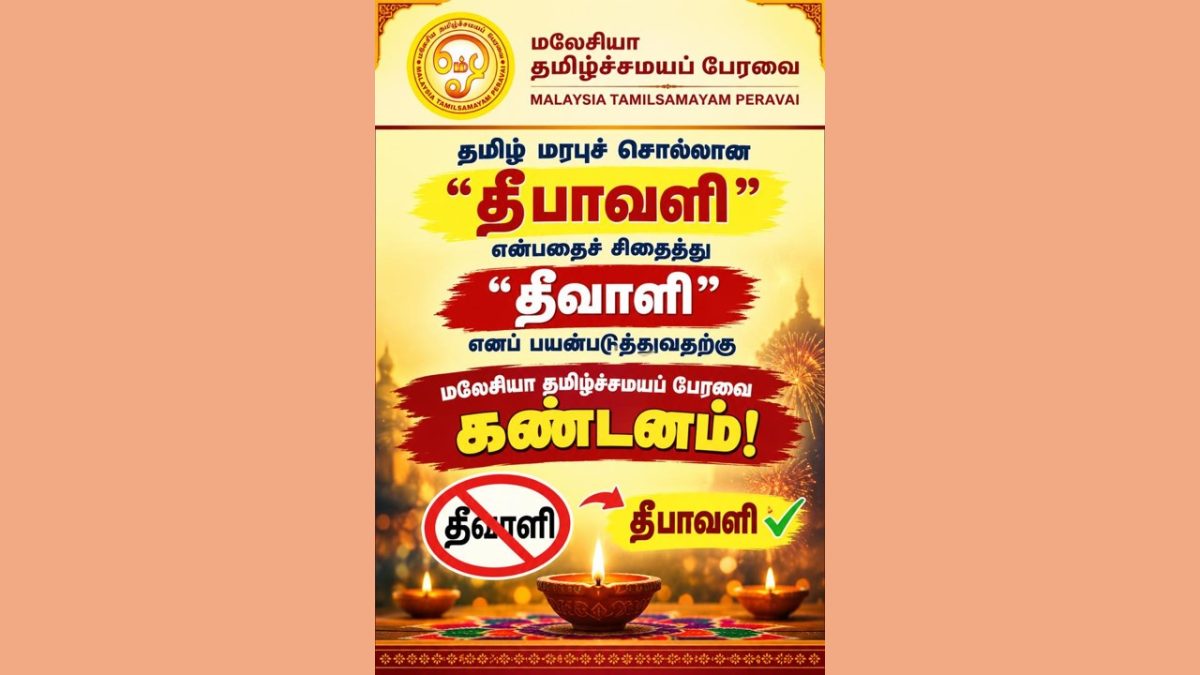
Malaysia Tamil Samaya Peravai (Malaysia Tamil Religious Council)
Concurrently, the Malaysia Tamil Samaya Peravai (Malaysia Tamil Religious Council) issued a public statement emphasising the importance of retaining “Deepavali” as an integral part of Tamil religious and cultural identity, urging media outlets, educational institutions, and public authorities to maintain correct spelling and traditional usage.
The statement issued by the Malaysia Tamil Religious Council reads as follows:
Malaysia Tamil Samaya Peravai Condemns Distortion of Traditional Term “Deepavali” to “Diwali”
Tamil is our community’s identity, the foundation of our culture, and the lifeline of our heritage. Preserving the traditional Tamil vocabulary and linguistic usage our ancestors passed down through generations is every Tamil’s duty.
In light of this, the Malaysia Tamil Samaya Peravai (Malaysia Tamil Religious Council) strongly condemns the growing trend of distorting the term “Deepavali”, a name that holds a prominent place in Tamil cultural and religious heritage, into “Diwali” (தீவாளி).
“Deepavali” is a time-honoured traditional term long established in Tamil society. When referring to such heritage words, it is essential to maintain their correct spelling and traditional usage. While natural linguistic evolution is understandable, altering traditional terms without valid cause raises serious concerns regarding language preservation.
Therefore, the Council urges the media, educational institutions, religious bodies, community organisations, and the general public to consistently use the correct written form of the term “Deepavali”.
All parties must act responsibly to safeguard the uniqueness of the Tamil language and Tamil religious and cultural traditions. In particular, we collectively have a responsibility to pass on the purity of Tamil and the importance of traditional terms to future generations.
Let us protect Tamil heritage!
Let us uphold the purity of Tamil words!
Let us use the traditional term “Deepavali”!
Malaysian Tamil Christian Development Council
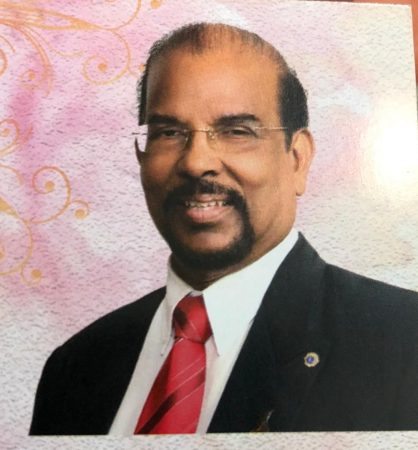
Another Tamil NGO, the Malaysian Tamil Christian Development Council, issued a statement supporting the use of the term Deepavali. The Council’s advisor, Mr Gnana Simon, also the former President of the Malaysian Tamil Writers Association, said in a press statement:
For generations, Indians worldwide have considered Deepavali their primary festival. This term has been consistently used for many years.
However, attempts to introduce a new, unused term like “Diwali”, thereby altering both the language and the identity of the Indian community’s festival, are strongly condemnable.
Decorative archways and banners for special festival stalls in Brickfields, Kuala Lumpur, have used the word “Diwali”. This is completely incorrect and erodes the festival’s essence and the community’s language.
Although “Deepavali” is a compound word derived from Sanskrit, it has a clear meaning: Deepam (lamp/light) + Aavali (row/array) = Deepavali (a row of lights). The term “Diwali”, on the other hand, holds no direct grammatical meaning in classical texts.
Discard a word with no legitimate connection to the language or the community. If laypersons made this mistake, it could be dismissed as unintentional ignorance; however, responsible authorities should not have made it.
The Indian community is deeply concerned that, despite Datuk Seri M. Saravanan, MIC National Deputy President and Member of Parliament for Tapah, writing a letter to Minister for Federal Territories Hannah Yeoh two weeks ago asserting that “Deepavali” is the correct term, the signage has still not been amended or corrected.
If such errors and trends persist in subsequent years, we risk quietly losing our language over time. We must recognise the danger that without our language, our identity as a community will naturally dissolve without anyone having to push us out.
Representing the Indian community, MIC Deputy President Datuk Seri M. Saravanan called upon the Minister to rectify the issue. In solidarity and driven by their devotion to the language, Malaysian Christian Tamil Development Council President Sebastian Thomas, Secretary Leo Mariyadas, and former President of the Malaysian Tamil Writers Association and Council Advisor Gnana Simon jointly urged authorities in their statement to immediately replace the decorative archways and banners in Brickfields with the correct term, “Deepavali.”