Tamil Nadu: Why DMK lost? The ‘Whistle’ revolution that propelled Vijay to a Historic Victory!
By R. Mutharasan
CHENNAI – In a political earthquake that has redefined the landscape of Tamil Nadu, actor-turned-politician Vijay has achieved what many seasoned analysts deemed impossible. By securing 108 seats and a majority as a solo contender, Vijay has not only dismantled the traditional DMK-AIADMK duopoly but has also surpassed the debut records of legendary icons like M.G. Ramachandran (MGR).
A Victory Scripted on Social Media
While traditional poll pundits predicted a familiar two-way battle, the results revealed a massive “silent revolution”. Unlike MGR, who spent five years building the AIADMK and relied on alliances with Communist parties to win in 1977, Vijay clinched power within just two years of forming his party—entirely on his own.
Political experts suggest this victory is a testament to the shifting medium of influence. Prof. James Chin of the University of Tasmania, a keen observer of Malaysian politics, has often argued that in today’s media savvy world, the party dominating social media wins elections. This theory held true in Tamil Nadu, where the digital wave bypassed traditional television debates to reach young and neutral voters directly.
The DMK’s Strategic Blunders
The downfall of the DMK is being attributed to a massive wave of anti-incumbency. Voters reportedly punished the ruling party for:
-
The handling of corruption scandals involving Senthil Balaji and K.N. Nehru.
-
Concerns over “dynasty politics” and the rise of drug-related crimes.
-
A perceived attempt to suppress dissent and anti-incumbency sentiments through expensive media advertisements.
Critics point out that major pro-government outlets like Sun TV completely ignored Vijay’s campaign, focusing instead on mocking AIADMK’s Edappadi Palaniswami. This strategy backfired, as it left the DMK unprepared for the grassroots momentum building for Vijay on social media platforms like YouTube and WhatsApp.
Emotional Highs and Personal Hurdles
The election was not without personal drama. The victory was marked by a poignant moment when Vijay visited his parents, S.A. Chandrasekhar and Shoba. Despite public disagreements where his father once claimed Vijay was being “misguided,” the two shared an emotional embrace following the win.
However, the absence of Vijay’s wife, Sangeetha, and his children during the celebrations was noted. The campaign was marred by personal attacks, including controversies surrounding his family life and allegations involving actress Thrisha. Yet, rather than damaging his image, these hurdles—along with strict campaign restrictions—appeared to create a “sympathy wave” among voters who viewed him as a David fighting a Goliath.
The Power of the “Whistle”
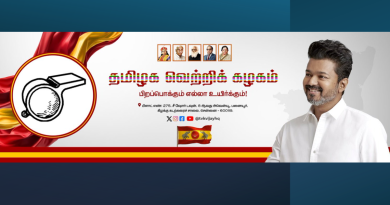
In a masterstroke of branding, Vijay’s choice of the “Whistle” symbol proved more effective than the decades-old “Rising Sun” or “Two Leaves.”
“While Dravidian symbols took years to etch into the public consciousness through wall paintings, the Whistle was shared instantly across millions of screens,” noted one journalist.
Even in remote southern villages, elderly voters were able to identify the symbol immediately—not by seeing it on a wall, but by the sound and gesture associated with it.
A Lesson for Modern Politics
This election serves as a wake-up call for veteran analysts who failed to pulse-check the younger generation. As Vijay’s supporters celebrate by blowing whistles across the state, the message is clear: the era of traditional rallies is being overtaken by digital dominance, and the voters of Tamil Nadu are no longer bound by the political scripts of the past.