

Bersama: Under Rafizi Ramli, another opportunity or further split for the Malaysian Indian vote bank?
By R. Mutharasan
-
Will Bersama contest the upcoming Melaka and Johor state elections?
-
Does this newcomer represent a genuine political alternative for the Indian community?
-
Are Malaysian Indian votes facing further fragmentation?
Anwar Ibrahim and Rafizi Ramli: Then and Now…
Nestled in the historic royal town of Kuala Kangsar, Perak, stands the Malay College Kuala Kangsar (MCKK). Established during the British colonial era, it was originally founded as an exclusive secondary residential academy for the Malay royalty. Following independence, the Ministry of Education reformed this policy, throwing open its doors to top-performing Malay students from all socio-economic backgrounds, after which the institution was officially renamed Kuala Kangsar Malay College.
In 1994, the college’s prestigious graduation ceremony featured a highly distinguished guest invited to present accolades to the year’s top achievers: the then-Deputy Prime Minister and Minister of Finance, Datuk Seri Anwar Ibrahim. Notably, Anwar himself was an illustrious alumnus of the institution. During the ceremony, as the student selected as the top overall achiever across all academic streams was called to the stage, Anwar personally presented him with the coveted Carey Award for Student of the Year.
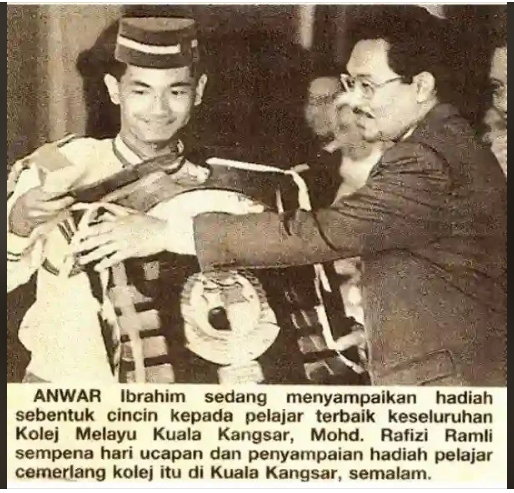
The brilliant young student from Terengganu receiving that honour from Anwar’s hands was none other than Mohd Rafizi Ramli.
That initial introduction on a graduation stage in 1994 forged a powerful political alliance in the decades that followed. Joining PKR to anchor Anwar’s ultimate rise, Rafizi fought relentlessly on numerous fronts, championing street demonstrations, navigating intense internal party power struggles, and exposing major Barisan Nasional (BN) corruption scandals with forensic, documented evidence.
Consequently, Rafizi climbed the party ranks to become the Deputy President of PKR. However, in the shifting tides of political fortunes, last year’s (2025) internal PKR elections saw Anwar’s daughter, Nurul Izzah, contest the Deputy presidency and defeat Rafizi. The severe internal rifts resulting from this bruising electoral defeat triggered a complete political realignment. Today, Rafizi has assumed the helm of the political entity: Parti Bersama Malaysia. Joining him in this high-stakes venture is Setiawangsa Member of Parliament, Nik Nazmi. Charting an entirely new political path, both leaders have already officially resigned their parliamentary seats.
The Looming 16th General Election

The nation’s 16th General Election (GE16) is steadily drawing closer. Typically, political battlegrounds begin to heat up an entire year before a nationwide poll is called. While the incumbent Unity Government holds a legal mandate until November of next year (2027), speculation is mounting that parliament will be dissolved much sooner, potentially within this very year (2026). In line with these predictions, the country’s political landscape is rapidly shifting under the weight of unexpected developments.
The compounding pressures brought about by these sudden political shifts, alongside the ongoing challenges of managing the ruling Madani Unity Government, suggest that Prime Minister Datuk Seri Anwar Ibrahim is already actively preparing to face the polls. This is evident from his recent strategic manoeuvres. In such a volatile environment, Rafizi Ramli’s launch of a new adversarial party has added intense fuel and immense excitement to the political arena.
Will Anwar Call the Election This Year?
To analyse this question effectively, one must examine the situation from Anwar Ibrahim’s perspective while sitting in the Prime Minister’s chair. Anwar’s greatest structural advantage is that he possesses the constitutional authority to remain securely in power until November of next year without an immediate threat. Therefore, it is highly doubtful that he would prematurely trigger a general election ahead of time and needlessly risk his premiership.
Anwar’s government would face a true existential threat only if Barisan Nasional, a crucial component of the ruling coalition, suddenly withdrew its support to align with opposition forces like PAS and dissatisfied PKR MPs, thereby commanding a new majority in parliament. Only if a vote of no confidence were successfully brought against him, threatening an imminent ouster, would Anwar be compelled to dissolve parliament preemptively and call GE16 early.
From another angle, state legislative assembly elections in Melaka, Johor, and Sarawak must be held in close succession. The prospect of Barisan Nasional and Pakatan Harapan (PH) forging a unified seat-sharing formula to contest these three state elections as a single front has certainly crossed the minds of both Anwar and UMNO President Datuk Seri Ahmad Zahid Hamidi.
However, immense practical hurdles and ideological contradictions persist at the grassroots level. Consequently, alternative recommendations are being actively considered and modelled on the Sabah state election format. Under this strategy, coalition partners would contest every seat directly and subsequently negotiate a state or federal alliance post-election, based on the final number of seats won.
Will Bersama Contest the Johor Election?

The Melaka state election must be held by the end of this year, followed by the Johor state election early next year (2027). A compelling question has emerged over whether Rafizi’s Bersama party will enter the fray in these two critical state polls.
Regarding the Johor state election, Menteri Besar Datuk Onn Hafiz Ghazi has already firmly announced that the state Barisan Nasional will contest all 56 state assembly seats completely on its own.
Currently, Barisan Nasional holds a commanding 40 seats in the Johor State Assembly (UMNO holds 33, MCA holds 4, and MIC holds 3). Among the remaining seats, Pakatan Harapan holds 12 (DAP holds 10, PKR holds 1, and Amanah holds 1). The opposition coalition, Perikatan Nasional, holds just 4 seats (Bersatu holds 2, PAS 1, and MUDA 1).
Although Barisan Nasional and Pakatan Harapan jointly lead the Madani Unity Government at the federal level, Barisan Nasional administers the Johor state government independently. When reviewing the current seat distribution and the potential friction in a seat-sharing formula, severe contradictions are bound to arise. Therefore, it is widely anticipated that these coalitions will enter the Johor state election as separate, competing entities.
What happens if Rafizi’s Bersama enters the fray independently?
If Rafizi’s Bersama party contests the Johor and Melaka state elections independently or in alignment with minor third parties, it will trigger a major political dilemma over which established coalition’s vote bank will suffer the heaviest damage. This scenario closely mirrors the political impact recently caused by actor-turned-politician Vijay and his Thamizhaga Vettri Kazhagam (TVK) party in the Tamil Nadu political arena.
While debates raged over whether Vijay would siphon votes from the DMK or the AIADMK, the final election results proved surprising. In traditional AIADMK strongholds like Coimbatore and Salem, Vijay’s party split the AIADMK vote share to secure victories. Simultaneously, in constituencies like Chennai and Madurai, which were viewed as absolute DMK bastions, TVK candidates fractured the DMK vote bank to emerge victorious.
Rafizi Ramli could trigger an identical, disruptive shift in Malaysian politics. At present, Rafizi is widely perceived on the ground as the true, authentic face of the Reformasi (reform) movement. Consequently, in the upcoming polls, whether the state elections in Melaka and Johor or the federal parliamentary election, Rafizi is bound to severely fracture the vote bank of at least one major coalition which likely to be Pakatan Harapan. Who ultimately benefits from this disruption will be decided only when the final ballot boxes are opened.
Read More:
Rafizi Ramli’s new party: A new hope or further split for the Indian Vote Bank?
Where does this leave the Indian community?
Rafizi’s new political movement is highly likely to attract specific segments of the Malaysian Indian community, including political neutrals, those deeply dissatisfied with the performance of incumbent parties, youths who have remained detached from political movements, and those who firmly believe in the core tenets of Reformasi.
However, whether this new political avenue will prove to be a blessing or a curse for Malaysian Indians remains to be seen. Just as Rafizi targets and splits the traditional Malay vote bank, his Bersama party will undoubtedly split the Indian electorate as well.
The Indian community’s political strength is already highly fragmented among MIC, PKR, DAP, MUDA, and Indian-centric parties such as IPF, Makkal Sakthi, and KIMMA. A segment of this divided electorate will now inevitably gravitate toward Bersama. As a direct consequence, the collective bargaining power of the Indian vote bank risks being further diluted and fractured in the upcoming state and general elections.
Ultimately, whether Rafizi’s Bersama will dissolve into a minor party that merely splits votes or rise as a formidable force capable of changing the entire trajectory of Malaysian politics and becoming part of the next government to be formed after 16GE is a question that only time will answer.